Featured

Table of Contents
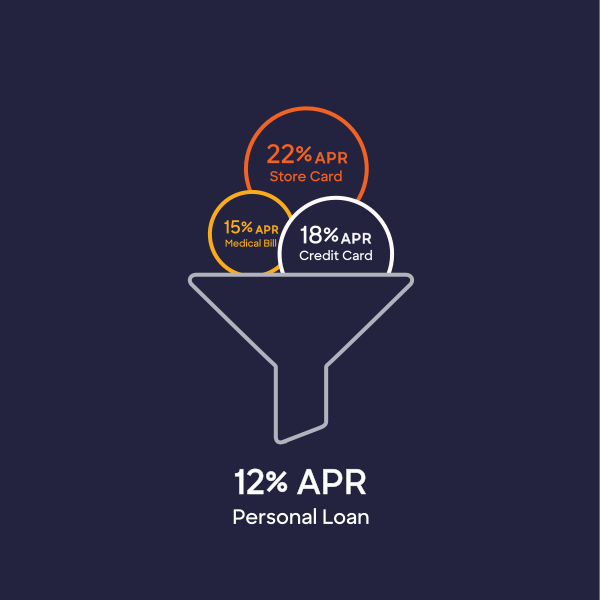
Financial obligation consolidation with an individual loan uses a couple of advantages: Fixed interest rate and payment. Personal loan financial obligation consolidation loan rates are typically lower than credit card rates.
Customers typically get too comfortable just making the minimum payments on their credit cards, however this does little to pay for the balance. In reality, making just the minimum payment can cause your credit card financial obligation to hang around for decades, even if you stop using the card. If you owe $10,000 on a credit card, pay the typical charge card rate of 17%, and make a minimum payment of $200, it would take 88 months to pay it off.
Contrast that with a debt combination loan. With a debt consolidation loan rate of 10% and a five-year term, your payment only increases by $12, but you'll be complimentary of your debt in 60 months and pay simply $2,748 in interest.
Essential Debt Calculators for Accurate 2026 PlanningThe rate you get on your individual loan depends upon numerous elements, including your credit score and income. The most intelligent way to understand if you're getting the best loan rate is to compare offers from completing lenders. The rate you receive on your debt consolidation loan depends upon numerous factors, including your credit history and earnings.
Financial obligation debt consolidation with a personal loan might be right for you if you meet these requirements: You are disciplined enough to stop bring balances on your charge card. Your personal loan interest rate will be lower than your charge card rate of interest. You can afford the individual loan payment. If all of those things do not use to you, you may require to try to find alternative methods to combine your debt.
Essential 2026 Planning Tools for Borrowers
In many cases, it can make a debt issue even worse. Before combining debt with an individual loan, consider if among the following scenarios uses to you. You know yourself. If you are not 100% sure of your ability to leave your charge card alone as soon as you pay them off, don't combine debt with a personal loan.
Individual loan rates of interest typical about 7% lower than charge card for the very same debtor. But if your credit ranking has suffered given that getting the cards, you might not have the ability to get a much better rate of interest. You might want to deal with a credit counselor because case. If you have credit cards with low and even 0% initial rates of interest, it would be ridiculous to replace them with a more costly loan.
In that case, you may wish to utilize a charge card debt combination loan to pay it off before the charge rate starts. If you are simply squeaking by making the minimum payment on a fistful of charge card, you may not be able to decrease your payment with a personal loan.
Essential Debt Calculators for Accurate 2026 PlanningThis maximizes their earnings as long as you make the minimum payment. A personal loan is designed to be paid off after a particular number of months. That might increase your payment even if your rate of interest drops. For those who can't take advantage of a debt combination loan, there are alternatives.
Effective Strategies for Reducing Card Debt in 2026
Consumers with excellent credit can get up to 18 months interest-free. Make sure that you clear your balance in time.
If a debt combination payment is too high, one method to reduce it is to stretch out the payment term. That's because the loan is secured by your home.
Here's a contrast: A $5,000 personal loan for debt combination with a five-year term and a 10% rate of interest has a $106 payment. A 15-year, 7% rate of interest second home loan for $5,000 has a $45 payment. Here's the catch: The total interest expense of the five-year loan is $1,374. The 15-year loan interest expense is $3,089.
Is Consolidation Right for You in 2026?
However if you really need to reduce your payments, a second mortgage is a great alternative. A debt management strategy, or DMP, is a program under which you make a single regular monthly payment to a credit counselor or debt management expert. These firms typically provide credit counseling and budgeting advice too.
When you get in into a strategy, understand just how much of what you pay every month will go to your lenders and just how much will go to the business. Learn for how long it will require to end up being debt-free and make sure you can afford the payment. Chapter 13 bankruptcy is a financial obligation management strategy.
One advantage is that with Chapter 13, your lenders need to get involved. They can't pull out the method they can with financial obligation management or settlement strategies. When you submit bankruptcy, the insolvency trustee determines what you can reasonably manage and sets your regular monthly payment. The trustee distributes your payment among your creditors.
, if successful, can discharge your account balances, collections, and other unsecured financial obligation for less than you owe. If you are very an extremely great arbitrator, you can pay about 50 cents on the dollar and come out with the financial obligation reported "paid as agreed" on your credit history.
Comparing Counseling versus Consolidation in 2026
That is extremely bad for your credit history and score. Chapter 7 bankruptcy is the legal, public variation of debt settlement.
Financial obligation settlement enables you to keep all of your belongings. With bankruptcy, released financial obligation is not taxable income.
Follow these ideas to ensure an effective financial obligation repayment: Discover an individual loan with a lower interest rate than you're currently paying. Sometimes, to pay back debt quickly, your payment must increase.

Latest Posts

How to Combine Credit Card Debt in 2026
Benefits of Nonprofit Credit Programs in 2026
Expert Tips for Managing Personal Debt for 2026